
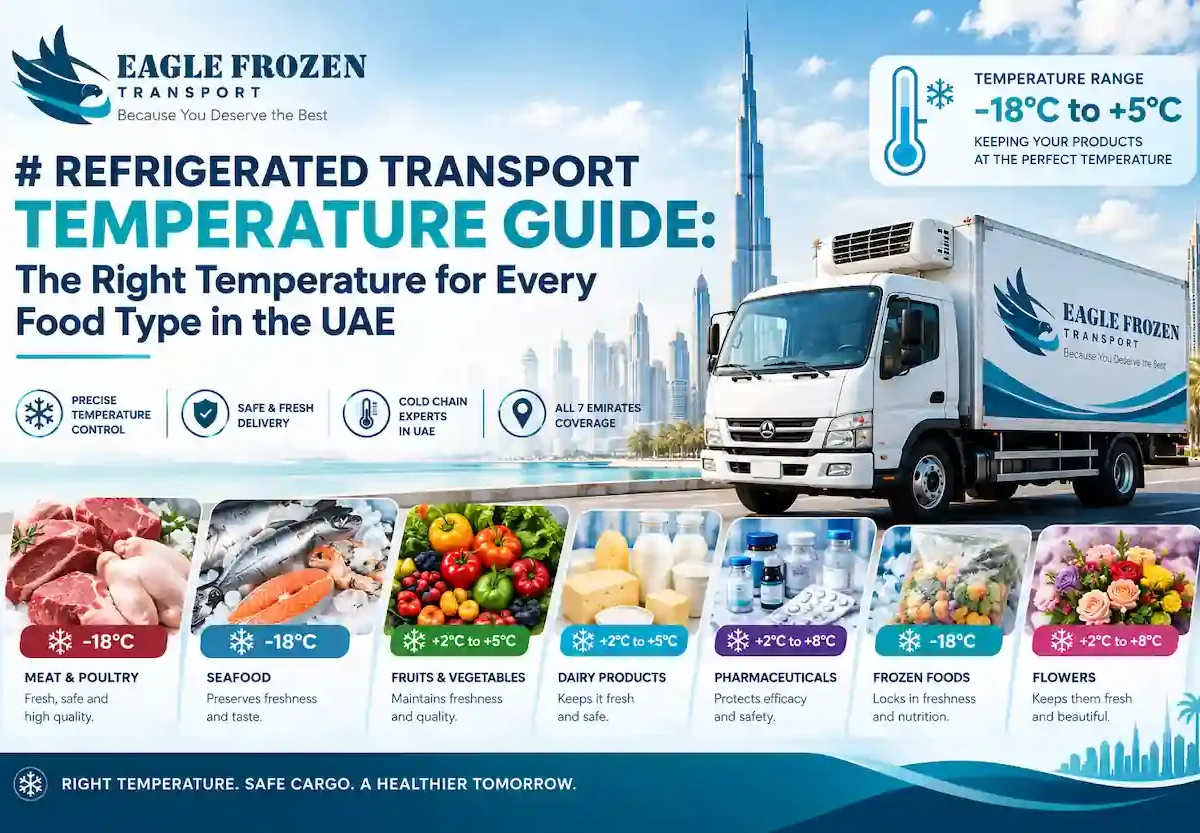
Refrigerated Transport Temperature Guide: The Right Temperature for Every Food Type in the UAE
Setting a refrigerated vehicle to “cold” isn’t enough. Every food category has its own safe transport temperature — and getting it wrong in either direction causes damage. Too warm and bacteria grow; too cold and fresh produce freezes, dairy separates, and chilled meat loses quality. In the UAE, where outside temperatures make every degree count, knowing the exact target matters even more.
This guide gives you the correct refrigerated transport temperature for each major food group, in one quick reference chart, followed by notes on the categories people most often get wrong.
Quick Reference: Refrigerated Transport Temperatures
| Cargo | Target transport temperature | Vehicle type |
|---|---|---|
| Fresh fruit & vegetables | +2°C to +8°C | Chiller |
| Milk, yoghurt, soft cheese | +2°C to +5°C | Chiller |
| Hard cheese, butter | +2°C to +8°C | Chiller |
| Chilled meat & poultry (fresh) | 0°C to +4°C | Chiller |
| Fresh fish & seafood (chilled, on ice) | 0°C to +2°C | Chiller |
| Eggs | +4°C to +8°C | Chiller |
| Bakery, cakes, desserts (chilled) | +2°C to +5°C | Chiller |
| Beverages, juices, soft drinks | +2°C to +8°C | Chiller |
| Cut flowers & plants | +2°C to +8°C | Chiller |
| Pharmaceuticals & vaccines (cold chain) | +2°C to +8°C | Chiller |
| Frozen meat & poultry | −18°C or colder | Freezer |
| Frozen fish & seafood | −18°C or colder | Freezer |
| Frozen vegetables & ready meals | −18°C or colder | Freezer |
| Ice cream & frozen desserts | −20°C to −25°C | Freezer |
General industry guidance. Always follow the specific storage instructions on the product label or from the supplier, and any requirements set by your local food safety authority.
In practice this means two vehicle families cover almost everything: a chiller van or chiller truck running at 0°C to +8°C for anything fresh, and a freezer van or freezer truck at −18°C to −25°C for anything frozen. The rest is choosing the right point within that range for your specific cargo.
Fresh Produce: Cold, But Never Frozen
Fruit and vegetables are the category most often damaged by over-cooling. Below about +2°C, many types suffer chill injury — bananas blacken, tomatoes go mealy, cucumbers pit, and leafy greens wilt once thawed. Keep produce in the +2°C to +8°C band, and avoid setting a chiller van to 0°C “just to be safe” when carrying mixed fresh goods. If you regularly move both produce and chilled meat, either run them at a compromise of around +3°C to +4°C or split the loads.
Dairy: The Tightest Window
Milk and soft dairy have the narrowest safe range — ideally +2°C to +5°C. A few degrees warmer shortens shelf life dramatically; a few degrees colder risks freezing and separation. Dairy is also one of the most sensitive categories to door-open time, so it benefits most from fast loading and minimal stops. Our chiller vs freezer van guide explains why dairy must never travel in a freezer vehicle, even briefly.
Chilled Meat, Poultry and Seafood: As Close to 0°C as Possible
Fresh meat and poultry should travel at 0°C to +4°C, and chilled fish and seafood even lower — 0°C to +2°C, ideally on ice. These are the categories where a warm van does the most harm fastest, because bacterial growth accelerates sharply above +4°C. For these loads, a well-maintained chiller vehicle, pre-cooled before loading, is essential — not optional.
Frozen Goods: −18°C Is the Floor, Not the Target
−18°C is the legal and industry minimum for frozen food storage and transport in most markets — but “minimum” is the key word. Frozen meat, seafood and ready meals are safe at −18°C, and colder is better for quality. Ice cream is the exception that needs extra margin: it should travel at −20°C to −25°C, because it begins to soften and form ice crystals well before it fully thaws. This is why we run freezer vehicles at −18°C to −25°C rather than sitting exactly on the line — it gives the load a buffer against the UAE heat during loading and handover.
Pharmaceuticals and Vaccines: Precision Over Everything
Most refrigerated medicines and vaccines require a strict +2°C to +8°C cold chain, and unlike food, there’s usually no “acceptable” excursion — a product that goes out of range may have to be discarded. Pharma transport needs a calibrated, monitored chiller vehicle, minimal handling, and documented temperature control from pickup to delivery. GPS tracking and a reliable cooling unit aren’t a luxury here.
Three Rules That Apply to Every Category
- Pre-cool the vehicle before loading. The cargo area should already be at target temperature when the first item goes in. Loading into a warm van means the cargo has to cool the vehicle, not the other way round.
- Never mix chilled and frozen in one compartment. A −18°C freezer will damage chilled produce and dairy; a +4°C chiller will thaw frozen goods. Use the right vehicle for each — or two vehicles.
- Minimise door-open time. Every second the doors are open in summer, the interior warms. Load fast, close immediately, and plan stops so the most sensitive cargo is delivered first. Our cold-chain tips for the UAE summer cover this in detail.
Getting the Temperature Right Starts With the Right Vehicle
Every Eagle Frozen Transport vehicle is set to your cargo’s exact requirement before it leaves — chiller vans and trucks from 0°C to +8°C, freezer vans and trucks from −18°C to −25°C — and monitored throughout the journey. If you’re not sure what temperature your goods need, tell us what you’re moving and we’ll set it correctly, whether it’s a single chiller van for a cafe or a 3-ton or 5-ton truck for bulk distribution.
Contact our team for a free quote — available 24/7 across all seven emirates.