
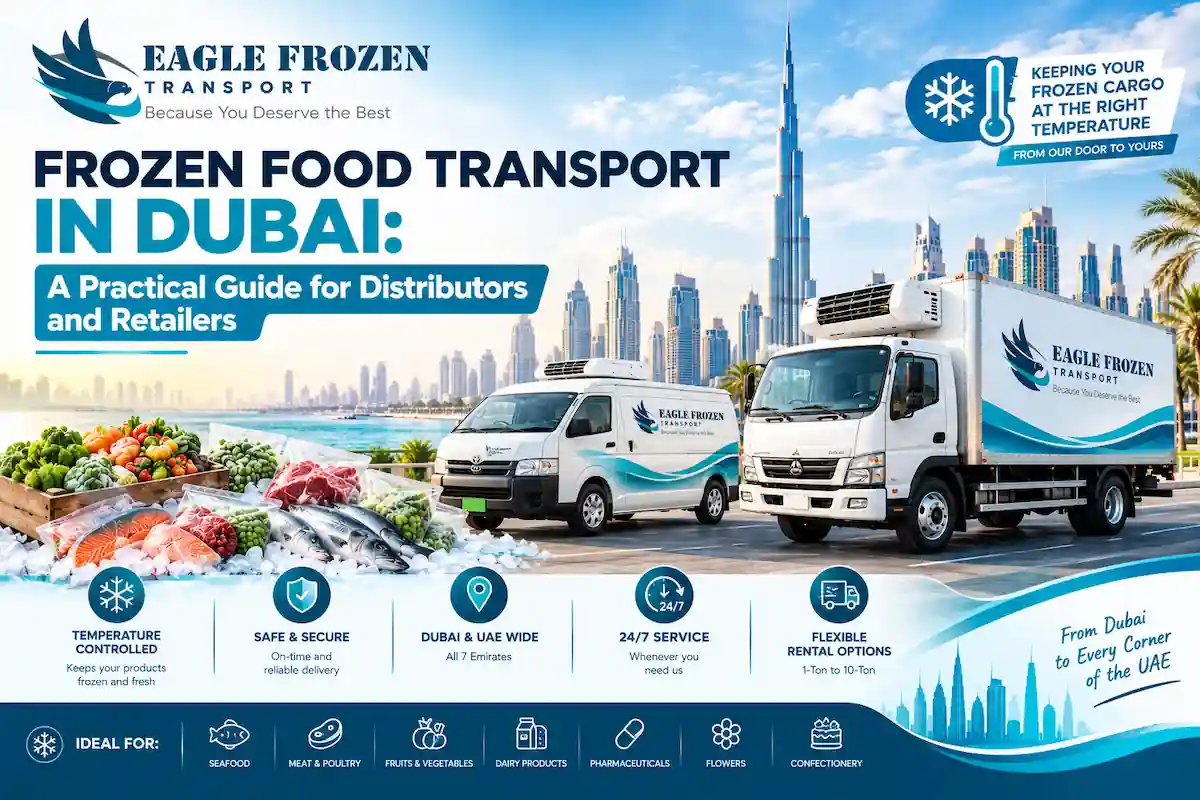
Frozen Food Transport in Dubai: A Practical Guide for Distributors and Retailers
Frozen food is one of the fastest-growing categories in the UAE’s food market — and one of the least forgiving to move. Unlike chilled goods, frozen products give you almost no margin: once ice cream softens or frozen meat starts to thaw, the damage is done and can’t be reversed. For distributors, wholesalers and retailers, getting frozen food transport right isn’t a nice-to-have — it’s the difference between a delivery that sells and one that’s written off.
This guide covers how frozen food transport works in Dubai and across the UAE: the vehicles, the temperatures, the common failure points, and how to keep the chain unbroken from cold store to customer.
What Counts as Frozen Food Transport?
Frozen food transport means moving goods that must stay at −18°C or colder for the entire journey — frozen meat and poultry, seafood, frozen vegetables and ready meals, bakery, and ice cream. It’s a distinct discipline from chilled transport, which runs at 0°C to +8°C for fresh (but not frozen) goods. If you’re unsure which category your products fall into, our chiller van vs freezer van guide explains the split, and our refrigerated transport temperature guide lists the exact target temperature for each frozen food type.
The Vehicles: Freezer Vans and Freezer Trucks
Frozen distribution in the UAE runs on two vehicle types, chosen by volume:
- Freezer vans (1-ton to 3-ton) — for city distribution, retail restocking and moderate loads. A freezer van holds −18°C to −25°C and moves easily through Dubai traffic and tight delivery bays. Ideal for supplying restaurants, convenience stores and smaller retailers.
- Freezer trucks (3-ton and 5-ton) — for pallets, bulk consignments and multi-store distribution. A freezer truck carries far more and suits wholesale supply, hypermarket deliveries and long-haul frozen routes across the emirates.
If your volumes fall between the two, our vehicle size guide helps match load to vehicle so you’re not paying for empty space or making extra trips.
Why −18°C to −25°C, Not Just −18°C
−18°C is the industry and legal minimum for frozen food — but running a vehicle exactly at that line is risky. In the UAE, every door opening at a delivery point lets warm air in, and in summer the interior can climb several degrees in seconds. Running the freezer at −20°C to −25°C builds in a buffer, so even with repeated stops and 45°C outside air, the core of the load never crosses −18°C. This is why professional frozen transport doesn’t sit on the minimum — it stays comfortably below it.
The Four Points Where Frozen Chains Break
Most spoiled frozen loads fail at one of these four moments:
- Loading into a warm vehicle. If the freezer wasn’t pre-cooled, the load starts thawing immediately. Always load into a vehicle already at temperature.
- Slow or repeated door openings. Multi-drop routes are where frozen goods suffer most. Sequence stops efficiently and keep each door opening short.
- Overpacking. Cramming a freezer blocks airflow, creating warm pockets. Leave room for cold air to circulate around every pallet.
- The handover gap. Cargo left on a loading dock in the sun between vehicle and cold store can thaw in minutes. Move frozen goods straight from freezer to freezer.
Our cold-chain tips for the UAE summer go deeper on each of these.
Frozen Distribution Across the Emirates
Frozen demand isn’t limited to Dubai — supermarkets, hotels and distributors across the country need reliable frozen supply. A capable transport partner should cover the whole UAE:
- Dubai — full freezer van and truck fleet from our Dubai Investment Park base.
- Abu Dhabi — served directly from our Mussafah branch, including freezer van rental in Abu Dhabi for local frozen distribution.
- Sharjah, Ajman and Ras Al Khaimah — freezer delivery across the northern emirates.
- Fujairah and Umm Al Quwain — covered as part of our seven-emirate service area.
For the full breakdown of vehicles, sizes and coverage, see our complete guide to refrigerated transportation in the UAE.
What Frozen Distributors Should Look For in a Transport Partner
If you move frozen food regularly, the right partner saves you far more than the rental cost in avoided spoilage. Look for:
- Deep-freeze capability — genuine −18°C to −25°C, not just “cold”.
- Well-maintained, GPS-tracked vehicles — so a breakdown or warm unit doesn’t cost you a load, and you always know where your cargo is.
- Flexible plans — daily for peaks, monthly for steady routes. See what affects pricing in our refrigerated vehicle rental cost guide.
- Round-the-clock availability — frozen deliveries don’t only happen 9 to 5.
- Both driver and self-drive options — so it fits how your operation runs.
Move Frozen Food the Right Way
Eagle Frozen Transport LLC has handled frozen distribution across the UAE since 2006 — with freezer vans and trucks holding a steady −18°C to −25°C, GPS-tracked and maintained for the harshest summer conditions, available 24/7 from our Dubai and Abu Dhabi branches.
Whether you’re supplying a handful of stores or running bulk frozen distribution across all seven emirates, we’ll keep your load solid from cold store to customer. Contact our team for a free quote, or call +971 56 313 9266 any time.